
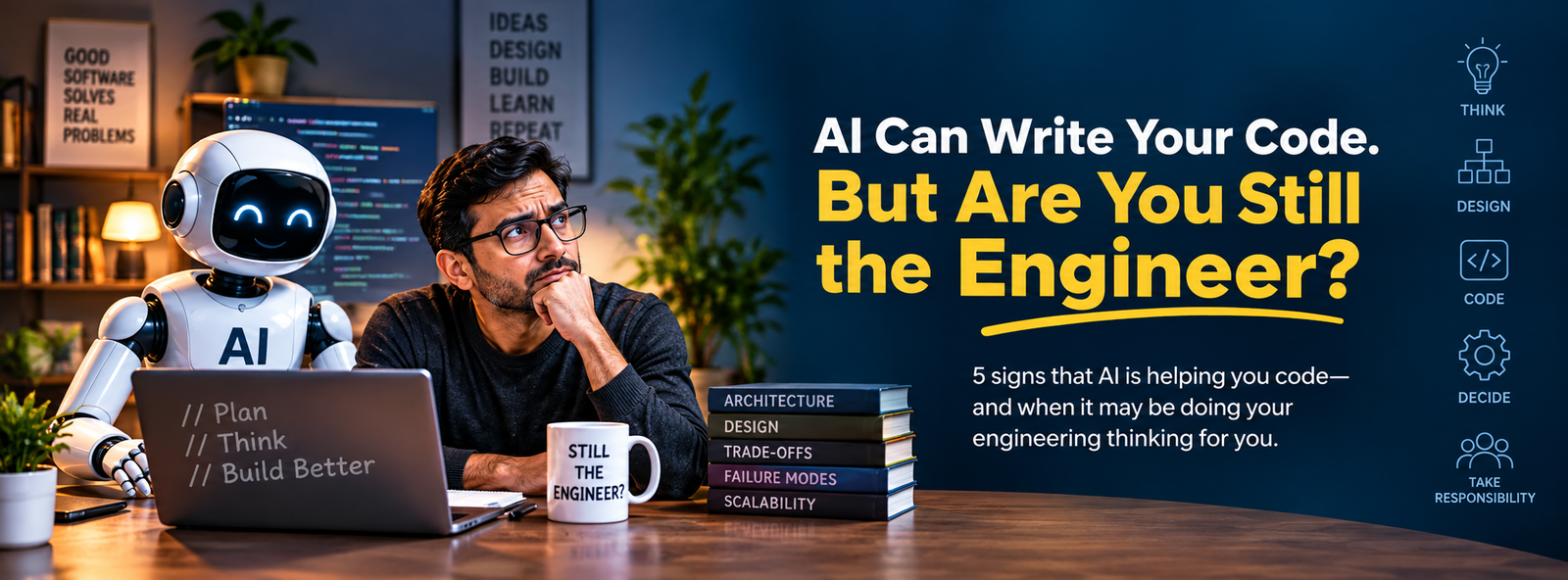
AI can write code in seconds.
But here’s the uncomfortable question:
If AI writes most of your code, how do you know you’re still the engineer?
AI-assisted software development has changed dramatically in the last few years. Tools such as GitHub Copilot, ChatGPT, Claude, and AI-powered IDEs can generate code, explain APIs, create tests, refactor existing implementations, and even build complete features from a short description.
For developers, this is an incredible productivity boost.
But it also creates an interesting problem.
There is a difference between using AI to engineer software and using AI to code instead of engineering.
You might be shipping features faster than ever. Your code might compile, your tests might pass, and your application might work.
And yet, you may be gradually outsourcing the most important part of software engineering: making and defending technical decisions.
Here are five symptoms that may indicate you are becoming more of an AI code generator than an engineer.
You Start Coding without Understanding the Problem
One of the easiest ways to identify an over-reliance on AI is to look at what happens immediately after receiving a requirement.
You open your AI coding tool and type:
“Build this feature.”
Within seconds, you have controllers, services, database models, API calls, UI components, and perhaps even tests.
It feels productive because something tangible has been created.
But software engineering doesn’t begin with implementation. It begins with understanding the problem.
Before writing code, an engineer needs to understand questions such as:
- Who is performing the operation?
- What resource is being accessed?
- What actions are allowed?
- What state can change?
- What state must be protected?
- What rules must always remain true?
- What happens if the operation fails?
- What should happen if the same operation is requested twice?
- What are the security and performance implications?
These decisions form the foundation of the implementation.
AI can help you explore these questions, but it should not quietly answer them for you.
This is particularly important because AI models are very good at filling in missing information. When your requirements don’t specify something, the model will often choose a familiar pattern or a reasonable default.
The resulting code may look perfectly professional. It may even work correctly in your initial tests but break later.
It is like hiring a builder who instantly constructs a beautiful, modern room on your house without checking where your plumbing lines run. It looks stunning, but the moment you try to live in it, the system breaks
If you regularly ask for implementation before you understand the problem, AI can gradually become a substitute for design rather than an accelerator of it.
Using Defaults Without Understanding the Trade-offs
AI-generated code often contains decisions that look perfectly reasonable.
A 30-second timeout.
Three retry attempts.
A five-minute cache.
A page size of 100.
A 60-minute token lifetime.
A particular database index.
A specific connection-pool size.
None of these choices necessarily look suspicious. In fact, they often look like sensible industry-standard values.
But an engineering decision isn’t justified simply because it is common.
The important question is:
Why is this value appropriate for this system?
For example, increasing retries may improve reliability when a temporary network problem occurs. But retries can also make an overloaded dependency even more overloaded.
Retrying a read operation may be harmless in some situations, while retrying a financial transaction without proper idempotency can create serious problems.
The same applies to timeouts and caching.
A timeout that is too short may cause unnecessary failures. One that is too long may cause requests to remain blocked for too long.
A cache can improve performance, but stale data may become a problem if the underlying information changes frequently.
An engineer doesn’t have to know the perfect value immediately. Engineering is often about making a reasonable decision and validating it through requirements, measurements, and real-world behavior.
The important part is being able to explain the decision.
AI is very useful for suggesting possible defaults. The problem is accepting those defaults without understanding their consequences.
If someone asks you why a particular configuration exists in your application and your answer is simply, “That’s what the AI generated,” then the decision isn’t really yours.
You Generate More Code Than You Can Understand
Before AI coding tools became mainstream, writing code was often one of the major bottlenecks in software development.
Today, that bottleneck is changing.
AI can generate hundreds of lines of code in seconds. Give it a sufficiently detailed prompt and it can create an entire feature, including database models, backend services, APIs, frontend components, tests, and documentation.
This creates an interesting imbalance: the ability to generate code can grow much faster than the ability to understand it.
That is where things can become dangerous.
Suppose an AI tool generates 800 lines of code for a feature. You review a few important sections, run the application, execute the tests, and everything appears to work.
Can you confidently say that you understand the remaining code?
This is an important question because code review is not simply about checking whether the application compiles or whether the tests pass.
A meaningful review requires understanding what the code does, why it does it that way, and how it behaves under different conditions.
You should be able to explain important architectural decisions, data flows, transaction boundaries, error-handling strategies, security assumptions, and dependencies.
This doesn’t mean you need to memorize every line.
Engineering has never been about memorizing code.
But there must be a reasonable relationship between the amount of code you accept and your ability to understand and take responsibility for it.
AI should reduce mechanical work so that you have more time for reasoning.
If it generates so much code that you can no longer review it meaningfully, then the productivity gain may be misleading.
You haven’t eliminated the work.
You’ve simply moved the risk somewhere else.
You Cannot Explain the Failure Modes
There is another important difference between simply developing software and engineering a system: engineers think about how things fail.
A developer focused primarily on implementation might ask:
“How do I make this API work?”
An engineer also asks:
“What happens when this API doesn’t work?”
Consider a simple operation that updates a record in a database.
The happy path may be straightforward. The request arrives, the application validates the input, updates the database, and returns a response.
But real systems rarely operate only on the happy path.
What happens if the database becomes unavailable?
What happens if two users update the same record at the same time?
What happens if the client sends the same request twice?
What happens if the network connection is interrupted after the database update but before the client receives the response?
What happens if a third-party service becomes slow?
What happens if a user sends malformed or malicious input?
What happens when the amount of data increases by a hundred times?
AI can be extremely useful in this area. You can ask it to identify failure scenarios, suggest defensive strategies, generate test cases, or review an architecture for potential problems.
But the engineer still needs to understand the failure modes.
A system isn’t robust simply because an AI-generated comment says // handle errors.
Robustness comes from understanding what can go wrong and deciding what the system should do when it happens.
This is also why production experience matters.
A feature that works perfectly in a development environment may behave very differently when it encounters real users, real data, network failures, concurrency, unexpected inputs, and dependencies that don’t behave as expected.
Production doesn’t care whether the code was written manually or generated by AI.
Someone still has to understand and own the consequences.
You Judge Code Whether It Works, Not Whether It Is Correct
This is perhaps the most subtle symptom.
You build a feature.
The application starts.
The API returns 200 OK.
The UI looks correct.
The test passes.
So you conclude that the implementation is correct.
But “it works” and “it is correct” are not necessarily the same thing.
A solution can work for the scenario you tested while still having serious problems.
Is it secure?
Is it maintainable?
Will it behave correctly with concurrent requests?
Does it scale as the amount of data grows?
Can you observe what is happening in production?
Does it preserve important business rules?
What happens when requirements change?
Can another developer understand it six months from now?
These questions are often invisible during a quick demonstration.
A solution can satisfy the immediate requirement and still be poorly designed for the system as a whole.
This is one reason experienced engineers spend significant time thinking about things that users may never see directly: architecture, boundaries, data consistency, security, observability, performance, failure handling, and maintainability.
The goal isn’t to make the code unnecessarily complicated.
The goal is to make deliberate trade-offs.
AI Isn’t the Problem
It would be easy to interpret all of this as an argument against AI-assisted development.
It isn’t.
AI is one of the most useful tools software developers have ever received.
An engineer can use AI to explore an unfamiliar technology, generate boilerplate, create unit tests, refactor repetitive code, explain a complicated API, investigate an error, compare implementation approaches, and build prototypes much faster.
There is nothing inherently wrong with generating a large percentage of your code with AI.
The important question is whether you understand and own the decisions behind that code.
In fact, the engineers who benefit the most from AI may be the ones who understand engineering principles deeply enough to use AI effectively.
They know what to ask.
They know what to question.
They recognize suspicious assumptions.
They can identify when generated code doesn’t fit their architecture.
They can review the output rather than simply accepting it.
And most importantly, they understand the consequences of the decisions they make.
The Role of the Engineer Is Changing
For a long time, software development rewarded the ability to translate requirements into code.
That skill is still valuable, but AI is rapidly reducing the amount of manual coding required.
As code generation becomes easier, the more valuable skills move further up the stack.
Instead of simply asking:
“Can you write this code?”
we increasingly need to ask:
“Do you understand what needs to be built?”
“Can you identify the important constraints?”
“Can you evaluate the trade-offs?”
“Can you recognize when the generated solution is wrong?”
“Can you explain how the system will behave when things go wrong?”
These are engineering skills.
The future of software engineering probably isn’t about competing with AI at typing code faster.
It is about becoming better at the things that surround the code: understanding problems, making decisions, evaluating trade-offs, managing complexity, and taking responsibility for the resulting system.
The Real Test
So, are you an engineer just because you write code?
Not necessarily.
And are you no longer an engineer because AI writes most of your code?
Definitely not.
The real test is what happens between the requirement and the generated implementation.
Do you understand the problem before asking AI for a solution?
Can you defend the important decisions?
Can you recognize assumptions that shouldn’t be there?
Can you review the generated code meaningfully?
Can you explain how the system can fail?
Can you determine whether a solution is actually correct rather than merely functional?
If the answer is yes, AI can make you a significantly more productive engineer.
But if AI is making the architectural decisions, choosing the defaults, generating the implementation, writing the tests, and explaining the result to you while your main job is pressing Accept, then something important has changed.
The problem isn’t that AI is writing your code.
The problem is when you stop understanding the code you’re responsible for.
AI can make software development faster.
But engineering is still about something deeper than producing code.
It is about making decisions you understand, can defend, and are willing to take responsibility for.
Frequently Asked Questions
Does using AI make me less of a software engineer?
No. Using AI to generate code doesn’t determine whether someone is an engineer. The important question is whether you understand, evaluate, and take responsibility for the decisions behind the generated code.
Will AI replace software engineers?
AI is changing the tasks software developers perform, particularly around code generation and repetitive implementation. The ability to understand systems, evaluate trade-offs, reason about failures, and make technical decisions remains important.
Should software engineers use AI coding tools?
AI can be useful for generating boilerplate, exploring technologies, writing tests, refactoring code, and investigating problems. The engineer should still review and understand the resulting implementation.
What is the difference between an AI developer and a software engineer?
The distinction isn’t how much AI someone uses. A software engineer is responsible for understanding the problem, making technical decisions, evaluating the solution, and taking responsibility for the resulting system.
Good explanation
Thanks for this blog, I am following you from last many years and learned a lot from your angular series